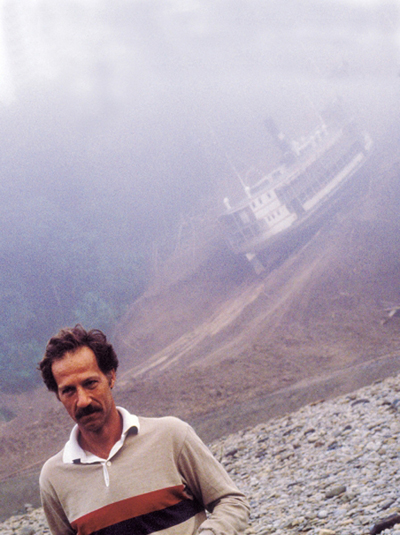
"In 1991 I built a small aluminum rowboat and started exploring the network of canals underneath downtown Providence Rhode Island. Since then I have built over 20 boats to explore cities in the U.S. and around the world."


Michael Stevenson
b. New Zealand, 1964
Answers to Some Questions about Bananas« is the re-telling of my encounters with the world’s first economic computer – a dedicated hydromechanical analogue from the 1950’s – and how this machine became embroiled in the politics of the developing world.
Known as the Phillips Machine, this hydraulic computer was developed at the London School of Economics by the New Zealand economist Bill Phillips who was at the time enrolled as a student. The Phillips Machine, standing almost 2m (6”) high is a representation of fiscal and monetary flows in a national economy.
The machine caused a sensation when it was first demonstrated at the L.S.E. In contrast to electronic computers of the day it is extremely visual: a fixed volume of water – dyed red to represent money – is pumped like blood through a circulatory system of transparent pipes and slices. The fluid accumulation in the various holding tanks becomes the measure for the economic data. Phillips built the machine to comprehend for himself certain theoretical problems. The solution to build a fluid model may trace back to his earlier employment on a hydroelectric dam and in the dairy industry.
The Phillips Machine soon became a popular teaching tool in university economics departments. In total perhaps 15 were produced and shipped to cities world wide including, Chicago, Melbourne, Istanbul, Boston, Amsterdam and Guatemala City. In the U.S. the noted ecomomist, Abba P. Lerner marketed and sold the machine, but under a new name – the Moniac. Lerner’s enthusiastic efforts lead to several sales including one in particular that interested me. In 1953 a machine was sold to the Banco de Guatemala (the Central Bank of Guatemala). It seems that through this sale the Moniac had entered several new worlds, it was no longer in the educational realm (rather it was in an institution that monitors money circulation) and, it was now in the developing world.
Charting a peculiar export of the 20th century – Western economists and their quixotic quest in the tropical world – my unfulfilled search for the lost Moniac purchased by the Central Bank led me to construct a facsimile of that model. The machine became the centrepiece of the installation and is seen in the context of a promotional film from United Fruit, the largest private landholder in Guatemala at the time. Together they allude to a tropical economy based on the banana and the thwarted search for national prosperity. My working replica Moniac was left unattended for the duration of the exhibition reducing it to a decrepit, ruinous, economic state.
This device increases the user’s likelihood of getting struck by lightning. Energy from the strike is transferred to heat, used to brand the user, who following the experience is left scarred as a memory of the event. The device questions the dissemination of this experience, from the life threatening, to simple story, the transition from the fantastic to the banal.